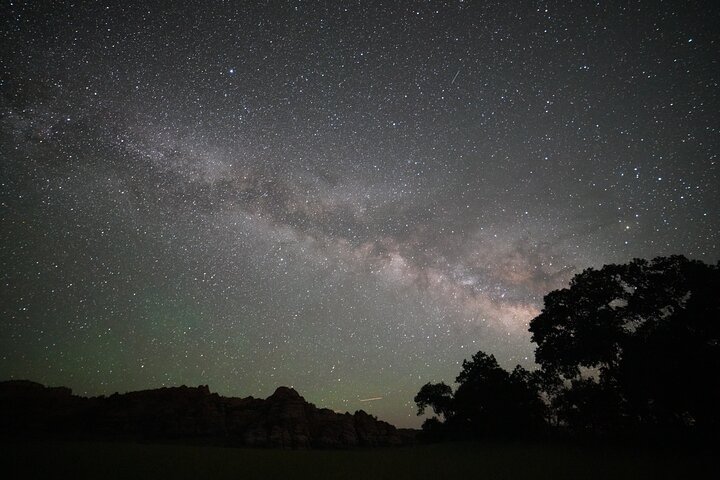
Experience the crystal-clear night skies of Greater Zion with a guided dark sky excursion. Choose from relaxing telescope viewings with cozy loungers or adventurous nighttime UTV rides through the desert dunes.
Free Cancellation East Zion Dark Sky Stargazing Tour
Free Cancellation Experience the night sky away from the crowds with guided stargazing in a quiet, scenic setting.
Free Cancellation Drive through sand dunes and red rock trails at night on a guided UTV adventure under Greater Zion’s dark skies.
Read what travelers share about their experience visiting Zion — from practical tips to personal highlights.
Zion's remote desert location and lack of urban light pollution make it a premier destination for discovering the night sky. On a stargazing tour, you will escape the daytime crowds to explore the cosmos with expert astronomy guides, powerful viewing equipment, and even off-road nighttime adventures.
Experience the Utah Milky Way in stunning clarity. Far from city lights, the sheer volume of visible stars is breathtaking.
Knowledgeable guides will help you navigate the night sky, pointing out constellations, planets, and deep-space objects while sharing fascinating astronomical facts.
Look through professional-grade telescopes and astro-binoculars to see celestial details you could never spot with the naked eye.
Some tours combine stargazing with a thrilling nighttime UTV ride through the rugged red rock trails and sand dunes of Greater Zion.
Premium tours prioritize your comfort by providing Yogibo loungers, warm blankets, and hot beverages so you can relax while looking up.
Thanks to the incredibly dark skies, many tour groups get lucky and witness shooting stars streaking across the desert sky.
Planning your nighttime adventure requires a little preparation to ensure you stay comfortable in the desert environment. Here is what you need to know before securing your spot under the stars.
You can choose from budget-friendly group astronomy sessions, premium small-group experiences with luxury loungers, or adrenaline-pumping guided UTV night rides. Tours typically last between one and two hours.
Most tours take place in Greater Zion or East Zion, just outside the official park boundaries, meaning you won't need to pay the $35 park entrance fee for the tour itself. Premium tours include extras like blankets and beverages.
Basic stargazing tours are suitable for all physical fitness levels, and some even allow strollers and service animals. However, UTV tours are not recommended for pregnant travelers or those with spinal or cardiovascular issues.
Stargazing requires clear skies. If heavy clouds or summer monsoon storms roll in, visibility drops. Fortunately, tours offer a full refund if you cancel at least 24 hours before your scheduled departure.
Desert temperatures drop rapidly after sunset, even in the summer. Dress in layers and wear closed-toe shoes so you stay warm while standing or lounging at the viewing sites.
Check-in locations vary widely based on the operator. You might be picked up in a white transit van, asked to meet at a specific dark-sky trailhead, or required to check in at a local recreation barn.
| Budget Astronomy Tour | Premium Small-Group Stargazing | Nighttime UTV Adventure | |
|---|---|---|---|
| Duration | 1 hour | 2 hours | 2 hours |
| Vibe / Best For | Families & budget travelers | Couples & deep relaxation | Thrill-seekers |
| Key Inclusions | Telescope viewing, tea and coffee | Telescopes, Yogibo loungers, blankets, beverages | Guided UTV ride, helmets, goggles, bottled water |
| Price from | $22.44 | $199.00 | $159.00 |
Zion National Park is officially open 24 hours a day, 7 days a week, making it fully accessible for independent nighttime exploration. If you are booking a guided stargazing tour, these typically begin shortly after sunset and run for 1 to 2 hours.
If you plan to visit park facilities before your night tour, keep in mind that the Zion Canyon Visitor Center Information Desk is open from 8:00 am to 7:00 pm during peak season, and the Zion Forever Park Store closes at 8:00 pm.
Most visitors travel to the Zion area by flying into Las Vegas International Airport (LAS), which is a 163-mile drive (about 2 hours and 45 minutes) via Interstate 15 North and UT-9 East. Alternatively, Salt Lake City (SLC) is about 4.5 hours away.
If you are staying nearby in St. George, you can take the SunTran Zion Route bus for just $5 each way. It runs Monday through Saturday until 10:30 pm, dropping you off right in Springdale. Tour operators will specify their exact meeting points, which are often in Springdale, East Zion, or Greater Zion.
The best months for stargazing are during the shoulder seasons of spring and fall (particularly October and November). During these months, the daytime temperatures are pleasant, and the night skies are crisp and clear.
June is also excellent because it is the driest month of the year, minimizing the chance of cloud cover. You should be cautious about booking in late July through September, as the summer monsoon season brings frequent evening thunderstorms that can completely obscure the stars and cause dangerous flash floods.
Accessibility depends heavily on the type of tour you choose. Standard stargazing experiences are generally suitable for all physical fitness levels, and some locations allow infants in strollers and service animals.
If you are heading into the park on your own, the Pa'rus Trail is a fully paved, 3.5-mile path that is wheelchair accessible and perfect for flat, safe nighttime viewing. Note that off-road UTV stargazing tours are strictly not recommended for pregnant travelers or those with spinal injuries due to the bumpy terrain.
If your stargazing tour meets inside or near the park, public restrooms are available at the Zion Canyon Visitor Center and various shuttle stops. The main visitor center lot has over 350 parking spaces, which are usually wide open at night, though they fill up completely by 9:00 am during the day.
For tours operating out in the sand dunes or remote East Zion locations, facilities may be limited to the initial check-in desk (like a recreation barn). Always use the restroom before heading out into the dark sky reserves.
The National Park Service enforces strict rules to protect the landscape and the visitor experience. Drones are strictly prohibited anywhere in the park, so you cannot use them to capture aerial night footage.
It depends on the tour's location. Many stargazing tours operate in Greater Zion or East Zion, outside the official park boundaries, meaning you do not need a park pass. If you enter the park independently to stargaze, you must pay the $35 private vehicle fee.
You should dress in layers. Even if daytime temperatures exceed 100 degrees, the desert cools down rapidly after sunset. Bring a light jacket or sweater, and wear sturdy, closed-toe shoes.
Yes, most dedicated astronomy tours provide high-powered telescopes and astro-binoculars. Your guide will set them up and calibrate them so you can view planets, constellations, and deep-space objects clearly.
Basic stargazing tours are very family-friendly and often allow infants and small children in strollers. However, if you book a UTV off-road stargazing tour, there may be age and size restrictions for safety on the rugged terrain.
Stargazing is heavily weather-dependent. If heavy cloud cover or summer monsoon storms prevent visibility, operators will typically cancel the tour. You can get a full refund if canceled at least 24 hours before departure.
To avoid light pollution, tours take place in remote areas. Depending on the operator, you might head to the sand dunes of Greater Zion, a recreation area in East Zion, or specific dark-sky pullouts near the park.
No, off-road vehicles like ATVs and UTVs are strictly prohibited on all roads and trails inside Zion National Park. Guided UTV night tours operate on the red rock trails and dunes outside the park's borders.
Yes, you can take personal photos, and guides often help you adjust your smartphone settings to capture the Milky Way. Note that commercial night photography workshops using tripods are banned on official park trails.
Yes, guided tours are very safe as you are with trained professionals who know the terrain. If you stargaze independently, stay away from steep cliff edges, carry a flashlight, and be aware of sudden flash flood risks during monsoon season.
Some tour operators operating outside the park allow service animals, but standard pets are usually restricted. Inside Zion National Park, dogs are only permitted on the paved Pa'rus Trail and must be leashed at all times.
Browse verified tours with free cancellation and instant confirmation.
Find Tours